
Tealium iQ and Adobe Launch, now named Adobe Experience Platform Tags, are enterprise tag management platforms designed to centralise the deployment of analytics, marketing and advertising technologies. Both provide controlled release processes, reusable configuration, data abstraction and support for complex tagging requirements.
The platforms are not interchangeable in practice. Tealium iQ is generally positioned as a vendor-neutral tag management layer with a strong data-layer and customer data platform orientation. Adobe Experience Platform Tags is more closely integrated with Adobe Experience Cloud, Adobe Experience Platform and the XDM data model.
The right choice depends less on the availability of individual features and more on the existing technology estate, operating model, data architecture, consent requirements, and governance maturity.
This comparison does not solve the wider implementation problem. Selecting a platform does not, by itself, create an accurate data layer, correct historical tracking defects, establish a consent-compliant deployment or guarantee reliable reporting. Those outcomes require design, testing, documentation and ongoing quality assurance.
1. Architecture and operating model
Tealium iQ uses a centralised tag management model. A site typically deploys Tealium’s Universal Tag, utag.js, after which tags, extensions, load rules and data mappings are managed through the Tealium interface. The approach is documented in Tealium’s overview of how Tealium iQ works.
Adobe Experience Platform Tags uses properties containing data elements, extensions, rules and libraries. Rules combine events, conditions, exceptions and actions. Libraries package implementation changes for deployment through configured environments. Adobe provides an overview of this model in its official Tags documentation.
The principal architectural distinction is as follows:
- Tealium iQ: a platform-agnostic tag management system that can support Tealium’s wider Customer Data Hub.
- Adobe Experience Platform Tags: a tag management and data collection layer that is particularly suited to Adobe Experience Cloud and Adobe Experience Platform implementations.
Neither model is inherently superior. The right choice depends on whether neutrality across vendors or alignment with the Adobe ecosystem is the primary requirement.
Recommended action: Map the current analytics, advertising, personalisation, consent and customer data technologies before selecting a tag management platform. The target architecture should be based on the full technology estate rather than on the tag manager in isolation.
2. Data layer and event model
Tealium iQ places the data layer at the centre of the implementation. The data layer commonly follows a Universal Data Object structure, with variables representing page context, products, customers, transactions and interaction events. These variables can then be used by load rules, extensions and tag mappings. Tealium’s data layer documentation describes the data layer as the foundation for the implementation.
Adobe uses data elements as a primary abstraction. A data element can retrieve and standardise values from JavaScript variables, cookies, query parameters, the DOM or other sources. Rules then use those elements to execute actions. In implementations using Adobe Experience Platform Web SDK, the data model may also be aligned with XDM.
The practical difference is significant:
- Tealium implementations often begin with a platform-independent data layer and map it to multiple destinations.
- Adobe implementations may begin with data elements and progressively align collection with Adobe’s XDM schema.
- Tealium can be a suitable fit where several analytics and marketing platforms must consume the same event model.
- Adobe can be a suitable fit where the primary objective is to standardise collection for Adobe Experience Platform and its Edge Network.
A poorly designed data layer remains a problem in either platform. Inconsistent naming, unclear ownership and incomplete event coverage will create unreliable reporting regardless of the user interface used to deploy the tags.
The GA4 event design guidance published by TagDataTrust illustrates the broader principle: event design should be controlled before implementation begins.
3. Rules, extensions and tag logic
Tealium iQ separates tags, load rules, extensions and data mappings. Load rules determine when a tag is eligible to load. Extensions can transform values, set variables, manage cookies or execute custom logic. Data mappings connect data-layer variables to vendor-specific fields. Tealium documents these capabilities across its sections on tags, load rules and extensions.
Adobe uses rules as the primary execution structure. A rule can contain one or more events, conditions and actions. Extensions provide vendor integrations and reusable functionality, while custom code can be used where an extension does not provide the required behaviour.
The distinction affects implementation governance:
- Tealium’s model makes tag configuration and firing eligibility visibly separate.
- Adobe’s rule model can make complex event-driven logic easier to sequence.
- Both platforms can support custom JavaScript, but extensive custom code increases technical debt.
- Both platforms support third-party integrations, although Tealium’s positioning is more explicitly vendor-neutral.
The number of tags is not a reliable measure of implementation complexity. A smaller implementation can still be difficult to govern if it contains overlapping rules, hidden dependencies or undocumented custom code.
Recommended action: Establish naming conventions, ownership rules, dependency documentation and a review process for custom code before migrating or expanding the implementation.
4. Environments, publishing and enterprise governance
Both platforms support controlled release workflows, but the terminology differs.
Tealium iQ uses profiles, revisions and publish environments. Changes can be saved, tested and promoted between environments. Tealium’s documentation covers version history, publishing workflows and version differences.
Adobe uses properties, libraries and environments. Libraries contain the implementation changes to be built and deployed. Adobe also supports multiple development environments and permission-based publishing. The Adobe enterprise publishing documentation describes the controlled movement of implementation changes into production.
For enterprise organisations, the important controls include:
- Separation of development, quality assurance and production.
- Role-based permissions.
- Documented approval points.
- Version history and rollback capability.
- Automated or repeatable deployment processes.
- Evidence that implementation changes have been tested against expected requests and outcomes.
Tealium provides APIs for managing configuration and revisions. Adobe provides the Reactor API and broader Adobe I/O capabilities. Either platform can support integration with internal deployment processes, although the surrounding skills and existing Adobe infrastructure may influence the practical effort required.
5. Consent and privacy controls
A tag management platform is not a complete consent management solution. Consent must be collected, stored, propagated and enforced in a way that matches the applicable legal and organisational requirements.
Tealium provides consent management functionality and documents integrations with external consent management platforms through its consent integration guidance. Tags can be configured to respect consent decisions through load rules and privacy controls.
Adobe implementations can use Adobe privacy and opt-in frameworks, consent signals and integrations with consent management platforms. The exact design depends on whether the implementation uses conventional vendor tags, Adobe Experience Platform Web SDK, Adobe Experience Platform services or a combination.
In both environments, common risks include:
- Marketing tags loading before consent is recorded.
- Consent categories being mapped inconsistently.
- Tags continuing to fire after consent withdrawal.
- Existing cookies and identifiers not being addressed correctly.
- Regional requirements being applied inconsistently across domains.
- Consent changes not being tested after website releases.
TagDataTrust’s CMP integration service covers the implementation considerations that sit outside the tag management platform itself.
Recommended action: Treat consent enforcement as a separate testable control. Test initial load, consent acceptance, consent rejection, withdrawal, regional variation and subsequent visits across every relevant domain and application.
6. Ecosystem and platform fit
Tealium iQ is generally more suitable where the technology estate includes several major vendors and platform independence is a priority. It supports integrations across analytics, advertising, personalisation, customer data and testing tools. Tealium’s tag marketplace and tag documentation provide the relevant implementation framework.
Adobe Experience Platform Tags is generally more suitable where Adobe Analytics, Adobe Target, Adobe Audience Manager or Adobe Experience Platform form the core of the digital data architecture. Adobe’s extension catalogue and Web SDK capabilities can reduce duplication within an Adobe-led environment.
The following decision criteria are useful: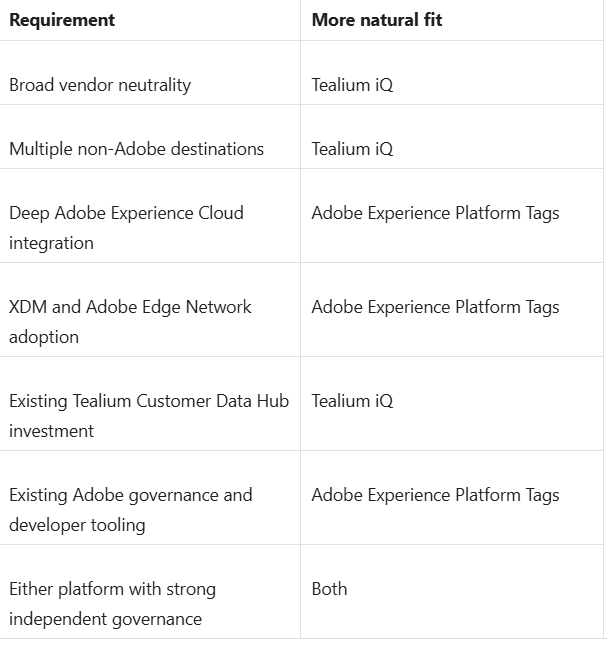
This is not a substitute for a technical assessment. Licensing, implementation history, internal capability, agency support and existing contracts can materially change the result.
7. A practical enterprise evaluation approach
A controlled evaluation should proceed in the following order:
- Document the current state. Inventory containers, tags, rules, extensions, data elements, data-layer variables, consent dependencies and destinations.
- Define the target data model. Establish event names, required parameters, ownership and destination mappings before rebuilding configuration.
- Assess platform dependencies. Identify whether the organisation requires vendor neutrality, Adobe XDM, mobile support, server-side collection or integration with a customer data platform.
- Build a representative proof of concept. Include page views, key interactions, ecommerce events, consent states, cross-domain journeys and error handling.
- Measure implementation quality. Compare network requests, payload values, load timing, duplicate firing, consent enforcement and downstream reporting.
- Define governance. Agree permissions, environments, release approvals, documentation standards and post-release monitoring.
- Plan migration or remediation. Avoid a direct recreation of undocumented legacy logic. Remove redundant tags and resolve data-quality defects during the transition.
The TagDataTrust tagging implementation service and analytics data quality guidance provide relevant context for this type of work.
8. Conclusion
Tealium iQ and Adobe Experience Platform Tags are both capable enterprise tag management platforms, but they are designed around different operational assumptions. Tealium iQ is generally better aligned with vendor-neutral architectures and broader destination flexibility. Adobe Experience Platform Tags is generally better aligned with Adobe-centric implementations, XDM-based collection and Experience Platform use cases.
The platform decision should therefore follow the wider implementation strategy, not lead it. In practice, the more important determinants of success are the quality of the data layer, the clarity of the event model, the treatment of consent, the discipline of the release process and the standard of post-release assurance.
A measured evaluation, supported by technical documentation and controlled testing, is more reliable than feature-by-feature comparison in isolation.
If you’d like to hear more on this topic and set up a 1:1 call with us, please use the contact form. Contact a Consultant